

AUTHORSHIP
8 June 2026
United O’Hare controversy brings gate access into focus for airline competition policy
Concerns over United Airlines' deliberate overscheduling at Chicago O'Hare brings attention to the role of gate access in airline competition
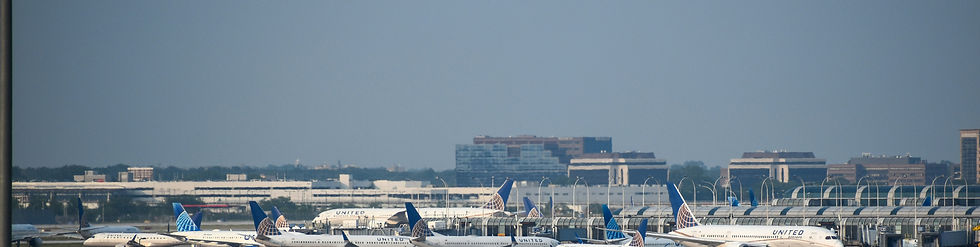
Attribution: David Syphers (Unsplash)
ISSUE AREAS
ANTITRUST & COMPETITION
I. Introduction
From the 1970s onward, the U.S. airline industry has become increasingly concentrated, reminiscent of broader trends across industries in this time period. A sector that once featured over a dozen major carriers has transformed into a market dominated by the so-called “Big Three” carriers (Delta Air Lines, United Airlines, and American Airlines), who alongside Southwest Airlines control some 80% of the U.S. market share. The dominance of these firms, buoyed by a wave of corporate mergers in the last fifteen years, has led to concerns over airline pricing power and fewer options for fliers. Accordingly, competition advocates and regulators have scrutinized major airline merger efforts, along with partnerships between carriers that raised concerns over possible violations of the Sherman Antitrust Act.
Beyond concerns over M&A in the airline sector leading to fewer carrier options, airline competition advocates have increasingly turned their attention to a specific factor that limits new entrants in the sector: airport gate access. Across the country, major airports increasingly serve as “hubs” of a single major carrier, which leverage control of airport gates to block other firms from competing. This incident gained renewed attention in 2026 over United Airlines’ controversial decision to overschedule flights at Chicago O’Hare International Airport in order to take advantage of its gate allocation process. This effort to take control of gates from rival American Airlines led to the Federal Aviation Administration (FAA) to limit the total number of flights out of the airport.
II. Calls for Reform
ADVOCACY EFFORTS
In June 2026, a coalition of consumer advocacy groups, including the American Economic Liberties Project and the Open Markets Institute ,sent a joint letter to leadership of the Department of Transportation (DOT) and the Department of Justice (DOJ) to urge continued vigilance on the issue. In the letter, the groups stressed the importance of preserving Chicago O’Hare’s increasingly rare status as a “dual hub” airport in the face of United’s efforts to dominate the airport.
As the letter notes, O’Hare’s gates are presently “allocated through long-term leases with the City of Chicago that rely on "use-it-or-lose-it" formulas,” a system that incentivizes carriers to maximize flights, even if it leads to congestion and potential delays for passengers. Alongside urging these agencies to review airport gate allocation mechanics at O’Hare, the letter also highlights concerns about a potential United—American merger.
This specific merger proposal, previously by United leadership earlier in 2026, had already been subject to scrutiny from consumer advocates as well as legislators of both parties. United CEO Scott Kirby, despite raising the possibility of this merger with the White House earlier this year, now publicly claims the company is disinterested. Despite this, in the absence of strong antitrust guardrails, it remains possible that United will pursue a merger with American or a separate rival such as JetBlue.
POSSIBILITY OF LEGISLATIVE REFORM
Though Congress’ efforts on aviation continue to primarily focus on matters of safety as well as merger policy, it is possible that the fiasco at O’Hare will lead to renewed focus on gate allocation matters. Two years ago, Sens. Elizabeth Warren (D-MA) and Josh Hawley (R-MO) introduced legislation known as the Airport Gate Competition Act to increase the number of “common-use gates” in U.S. airports. In the 2025 “Examining Competition in America's Skies” hearing, Frontier Airlines CEO Barry Biffle spoke to the committee about the importance of low-cost carriers in forcing legacy carriers to compete on price. In his testimony, Biffle explicitly called for Congress to confront airports’ “use-it-or-lose-it” rules, arguing major carriers should “not be allowed to hold preferential gates indefinitely without using them,” while also endorsing common use requirements.
III. Conclusion
At a time when the federal government is increasingly signaling a willingness to allow more airline consolidation, even as rising fuel costs raise prices for U.S. fliers, it’s likely that scrutiny of gate allocation rules that block competition will continue to mount. And with O’Hare’s continued status as a major airport where multiple major carriers are forced to compete in question, the cause of reforming gate allocation rules is likely to gain further salience.
Founder, Labyrinth Insights
