top of page


AUTHORSHIP
7 July 2026
Advocates call for antitrust probe of Netflix over pricing power, impact on creators
Newly-launched mobile billboard campaign urges probe of Netflix's anti-competitive conduct by the DOJ & FTC

Attribution: Venti Views (Unsplash)
I. Introduction
ISSUE AREAS
Long overshadowed in antitrust enforcement discourse by Big Tech companies, Netflix's failed acquisition of Warner Bros. Discovery (WBD), alongside broader concerns about media concentration, has heightened scrutiny of the streaming giant's market power. As previous Labyrinth Insights analysis noted, the failed acquisition left Netflix with few allies in Washington, D.C. of either party. After reaping a $2.8 billion windfall from the failed acquisition's breakup fee, the company drew further criticism for increasing subscription costs and spending on stock buybacks. The company's controversial impact on creative workers, including its practice of hiding viewership data and the streaming model's impact on compensation itself, is salient in an era where AI threatens jobs in the industry.
In April 2026, a civil society coalition including the Open Markets Institute, the American Economic Liberties Project, the Writers Guild of America West, and the Revolving Door Project, called on antitrust regulators to probe Netflix's market power and its impact on consumers and creators. On Tuesday, July 7, the Demand Progress Education Fund launched a mobile billboard campaign proclaiming "Netflix Is A Monopoly" outside of the Federal Trade Commission (FTC) and the Department of Justice (DOJ) buildings.
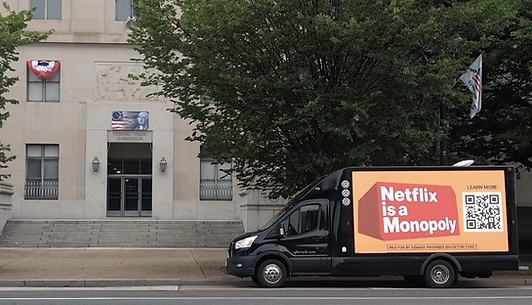
Source: Demand Progress (@DemandProgress) on X (formerly Twitter)
II. Criticism of Netflix's Practices
CONCERNS OVER PRICING POWER
Since unbundling its streaming service in 2011, Netflix has regularly raised prices on subscribers, with increases outpacing general inflation. From 2011 to 2025, the year Netflix's intent to acquire Warner Bros Discovery was announced, the cost of Netflix's Standard plan rose from $7.99 to $19.99; its Premium tier, which debuted in 2013, rose from $11.99 to $24.99. Netflix's decision to further raise prices after pocketing a substantial $2.8 billion breakup fee following the merger's collapse: as of March 2026, Standard and Premium subscribers must pay $19.99 and $26.99, respectively. One analysis based on 2015 to 2026 price trends anticipates the Standard plan to raise to $35.32 by 2035, with Premium reaching $43.68.
As the coalition letter noted, Netflix's ability to command a worldwide subscriber base of 325 million global subscriber base despite these price increases suggests a captive audience. The letter argues that despite consumer dissatisfaction, Netflix's control over an "extensive content library, vertically integrated production and distribution model, and access to substantial user data" prevents meaningful competition from arises. The letter goes to argue that "sustained price increases alongside limited switching may indicate that competition in streaming markets is not functioning effectively".

'GATEKEEPER' STATUS AND IMPACT ON CREATIVE ECONOMY
With control of some 33 percent of the subscription video streaming market, the coalition argues that Netflix's sheer scale gives it gatekeeping power over content distribution, and thus gatekeeper status in the entertainment industry. "When one firm attains gatekeeping power over distribution at scale," the groups wrote, "it can shape which voices are heard and on what terms creators participate in the market."
The letter notes that Netflix undermines competition by limiting access to viewership metrics, putting creators at a disadvantage. By preventing independent verifications of these numbers, the letter argues that Netflix is given an unfair advantage in the negotiating process, with the company empowered to "set compensation terms and shape content production decisions in ways that are difficult for creators and competitors to independently evaluate or contest". Entertainment industry figures have noted that increased consolidation in the sector has led to fewer opportunities for filmmakers and screenwriters due to fewer buyers. The rise of generative AI content and its impact on creative workers has made the issue a more salient one, with the FTC published a staff report on generative AI and the creative economy in December 2023.
III. Conclusion
In a political environment defined by an ongoing cost of living crisis, calls to probe Netflix's pricing power are likely to resonate with the general public. In an accompanying press release, Demand Progress Education Fund Executive Director Sean Vitka stated that "Netflix is using its market power to bully creators and viewers alike, and its attempt to acquire Warner Bros. means this is going to get worse". Adding that its "time for overseers to step in and investigate" the company's conduct, it's likely that pressure on Netflix will only mount given its damaged reputation in Washington.
Aidan Smith
Founder, Labyrinth Insights

bottom of page