

AUTHORSHIP
8 August 2026
American Airlines' refund rollback reflects industry's anti-consumer shift as DOT retreats on passenger protections
AA's retreat to the federal minimum on refunds illustrates broader erosion of passenger protections under a DOT led by a former airline lobbyist
Attribution: Ross Sokolovski (Unsplash)
ISSUE AREAS
CONSUMER PROTECTION
I. Introduction
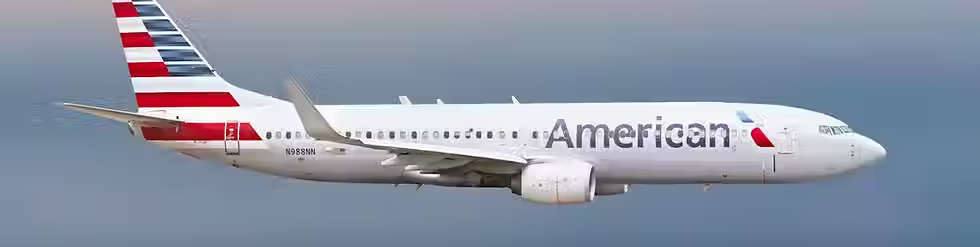
In late July, American Airlines (AA) quietly rolled back its policy allowing passengers to cancel last-minute bookings for a full refund within 24 hours of ticket purchase. The carrier, which previously maintained more flexible cancellation rules than most of its competitors, now defaults to the minimum requirement under federal law: the 24-hour refund window will only be available for passengers who purchased a ticket at least seven days prior to departure. This policy change is likely to be received as both arbitrary and unnecessarily confusing for passengers, many of whom stand to lose money given the quiet nature of the rollback.
Airlines have long been noted for having high levels of consumer dissatisfaction, with AA specifically ranked in 2025 as the most disliked airline in the world by a global study of passenger satisfaction. In the week preceding the rollback, AA was embroiled in a public relations crisis stemming from passengers being stranded at Philadelphia International Airport. However, at a time when market consolidation in the airline industry has hit record levels, AA has little motivation to deviate from these practices given it is unlikely to lose market share. Even amid widespread public frustration over rising flight prices and deteriorating quality of service, the carrier does not feel pressure to improve its consumer-facing policies.
AA's rollback coincides with a broader dismantling of passenger protections across the airline industry. Under the Trump administration, the Department of Transportation (DOT) has systematically weakened consumer safeguards, including those concerning flight delays and refunds. The convergence of corporate policy changes and federal deregulation is not incidental: the airline industry has invested heavily in lobbying the current administration, and the DOT under Secretary Sean Duffy has delivered on the industry's stated priorities with remarkable speed.
II. Regulatory Background and Industry Influence
ORIGINS OF FEDERAL PROTECTIONS
In 2011, the Obama-era Department of Transportation issued its 'Enhancing Airline Passenger Protections' rule. Among its provisions was a requirement mandating that customers who purchased tickets at least seven days before departure could receive full refunds if they cancel within 24 hours. The rule is a modest consumer safeguard, designed primarily to protect passengers who mistakenly booked a flight and needed to correct the error. Despite the modesty of the rule, it still resulted in staunch opposition from airlines, with the Air Transport Association of America (now Airlines for America) fighting the DOT in federal court. The D.C. Circuit would ultimately reject the organization’s claims that the mandate represented overreach, and the Supreme Court declined to hear a petition for certiorari the following year.
From 2017 until last month, AA was among the few major carriers that offered policies more generous than those set under this minimum federal standard. With AA eliminating its more generous policy, Delta is now the only “Big Three” carrier whose policies are more consumer-friendly than the federal minimum. As it stands, Delta continues to permit refunds for customers up until either the end of the day after a ticket is booked, or midnight of the date of the purchased flight. Last-minute travelers, who generally pay the highest fares, are disproportionately harmed by the policy change. Many travelers who book close-in flights do so not by choice, but due to unexpected circumstances such as family emergencies or sudden work obligations. Moreover, this sudden shift in policy is likely to further compound consumer confusion regarding airline rules. A 2025 global survey of airline passengers found that 7% of U.S. respondents were able to identify refund and compensation rights, the single lowest number in any nation surveyed.
DOT'S REGRESSION ON PROTECTING PASSENGERS
Following the 2024 election, Trump nominated Sean Duffy, a former congressman and lobbyist, as Secretary of Transportation. Duffy had previously worked at BGR Government Affairs representing the Partnership for Fair and Open Skies, a coalition that includes AA, Delta, and United. Under his leadership, the DOT has pursued a deregulatory agenda aligned with airline industry priorities. In line with the broader trend of corporations hiring lobbying firms tied to the Trump administration, Delta hired BGR Group, his former employer, to lobby on matters concerning the airline industry. Outside analysis in 2025 found that "deregulatory items" on the DOT's agenda exceeded that of the EPA and the Departments of Labor and the Interior combined.
Scrutiny of the Duffy-led DOT’s alignment with the airline industry came into focus following the withdrawal of proposed Biden-era rulemaking on “Airline Passenger Rights”. The proposed measure required that airlines compensate passengers in the event of significant flight delays. The proposal, reminiscent of longstanding passenger protection rules in place in the European Union, would have entitled U.S. passengers to between $200 and $775 in the event of severe disruptions. Following an extensive lobbying pushback from the airline industry, including Airlines for America, the DOT would abandon the proposal, citing its lack of alignment with "Department and administration priorities.” Additionally, the DOT would initiate a pause on rulemaking that would require airlines to provide refunds in the event of flight renumbering. William J. McGee of the American Economic Liberties Project, a leading consumer advocate on airline matters, criticized the DOT’s passenger protection rollback, likening it to having been “copy-pasted directly from Airlines for America.”
In December 2025, Democratic members of Congress wrote to the DOT Inspector General, urging an investigation into Duffy's potential conflicts of interest and whether they influenced the DOT’s decision to end passenger protection rules. The Duffy-era DOT’s rollback of passenger protection rules extends beyond delay compensation measures. In July 2026, the DOT took multiple actions to weaken existing safeguards, including through amending the “Full Fare Rule,” an airfare price transparency measure. The DOT additionally restored procedural mechanisms that will make it easier for carriers to challenge future rulemaking on unfair or deceptive practices. Amid the Duffy-era DOT’s deregulatory push, Airlines for America has urged the reversal of other existing rules, including requirements for cash refunds in the event of flight cancellations, as well as complimentary family seating policies.
PUBLIC DISCONTENT AND MARKET POWER
The dismantling of federal protections coincides with a period of mounting public frustration with airlines. A report published in 2025 by the U.S. PIRG found that complaints against U.S. airlines reached a record high in 2024, representing an increase of almost 9% from the year prior. The PIRG report found an increase in complaints concerning delays and cancellations. More recent survey data suggests around nine in ten passengers are concerned about potential delays or cancellations, underscoring the extent to which the industry has eroded consumer trust. But even as airlines face consumer backlash over unreliability and poor quality of service, the lack of real competition leaves flyers without alternatives. The modern airline industry is famously concentrated, with just three carriers controlling the overwhelming majority of domestic market share. The average domestic round-trip fare rose to $350 in March 2026, representing an increase of over $40 a year prior. Increases in airfare and fees (such as for checked bags) were presented as a necessary response to the Iran War’s impact on oil prices. Despite this, observers expect hiked prices to remain regardless of whether oil prices stabilize, with Delta CEO Ed Bastian admitting as much in April 2026.
The link between corporate consolidation and lobbying power is well-documented, and concentration in the airline industry gives carriers significant policy sway. The prospect of further consolidation in the future has been made more likely as a result of the Trump administration’s regression on antitrust enforcement. Earlier in 2026, United CEO Scott Kirby confirmed his interest in a combination with AA, thereby creating an entity that would have controlled roughly half of the domestic market. Though AA ultimately declined to pursue a merger, the lack of federal competition enforcement means there are no guardrails preventing United or another legacy carrier from pursuing a “mega-merger” in the future. Under the Biden administration, the DOT participated in the White House’s whole-of-government competition efforts, with Jen Howard being appointed chief competition officer in the department. In contrast, Duffy has positioned himself as amenable to proposed airline mergers, in alignment with the Trump administration’s hands-off approach to consolidation.
III. Conclusion
It is understandable that consumers are frustrated that airlines, long a recipient of taxpayer-funded bailout money, are willing to quietly reverse even the most modest of protections for flyers. For American Airlines, a company with a market cap of roughly $11 billion, the revenue impact of 24-hour cancellation policies is negligible. For the affected consumers, however, it can be financially debilitating, particularly for those who booked last-minute due to unexpected circumstances such as family emergencies. AA’s policy change is predictable given the federal government’s retreat from passenger protection, particularly given that passengers have few alternatives in a consolidated market.
Amid the DOT’s deregulatory push, lawmakers in Washington have pushed to codify passenger protections through proposals such as the Airline Passenger Compensation Act. Even prior to Duffy's ascension, members of Congress pushed for measures to safeguard flyer protections through proposals such as the “Passenger’s Bill of Rights”. Though passenger protection measures are exceedingly unlikely to pass in the current session, their introduction signals that industry-supported rule rollbacks will not go uncontested.
Founder, Labyrinth Insights
